
Face Search
What Does a Face Similarity Score Mean?
Face-search results are often ranked by similarity, but that number is easy to misunderstand. Learn what a facial similarity score measures — and what it cannot tell you.
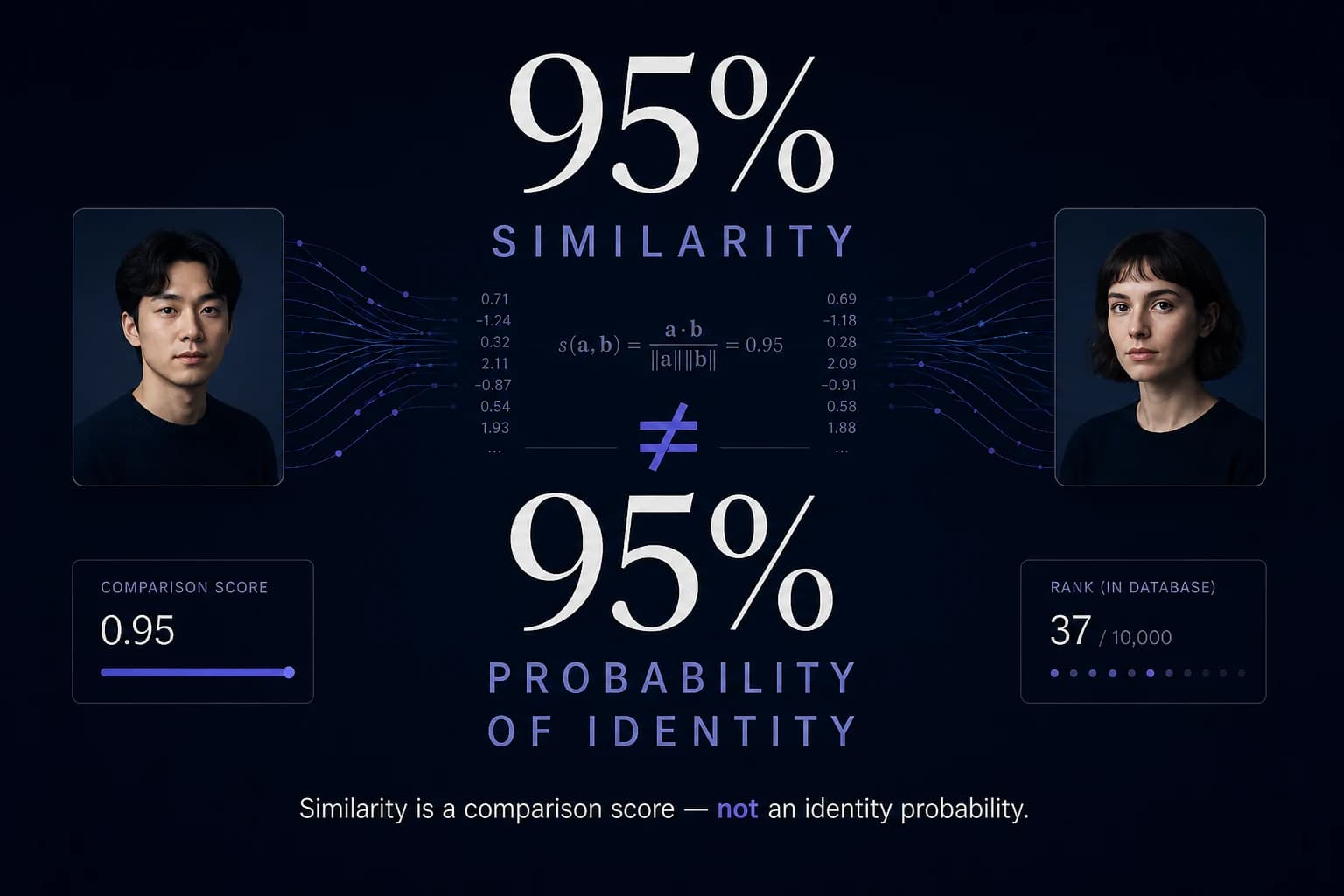
A high similarity score does not mean “we're 95% sure this is the same person.”
Face-search systems compare mathematical representations of faces and calculate how similar those representations are according to the recognition system being used.
That comparison can then help rank possible matches.
The resulting number might be displayed as a raw score, a percentage-like value, a confidence category, or another simplified indicator depending on the service.
But there's an important distinction:
Similarity measures the comparison between faces. It does not automatically measure the probability that two photos depict the same person.
Understanding that difference makes face-search results much easier — and safer — to interpret.
Where does the similarity score come from?
Modern face-recognition systems don't usually compare photographs by measuring a handful of obvious features such as nose width or eye spacing.
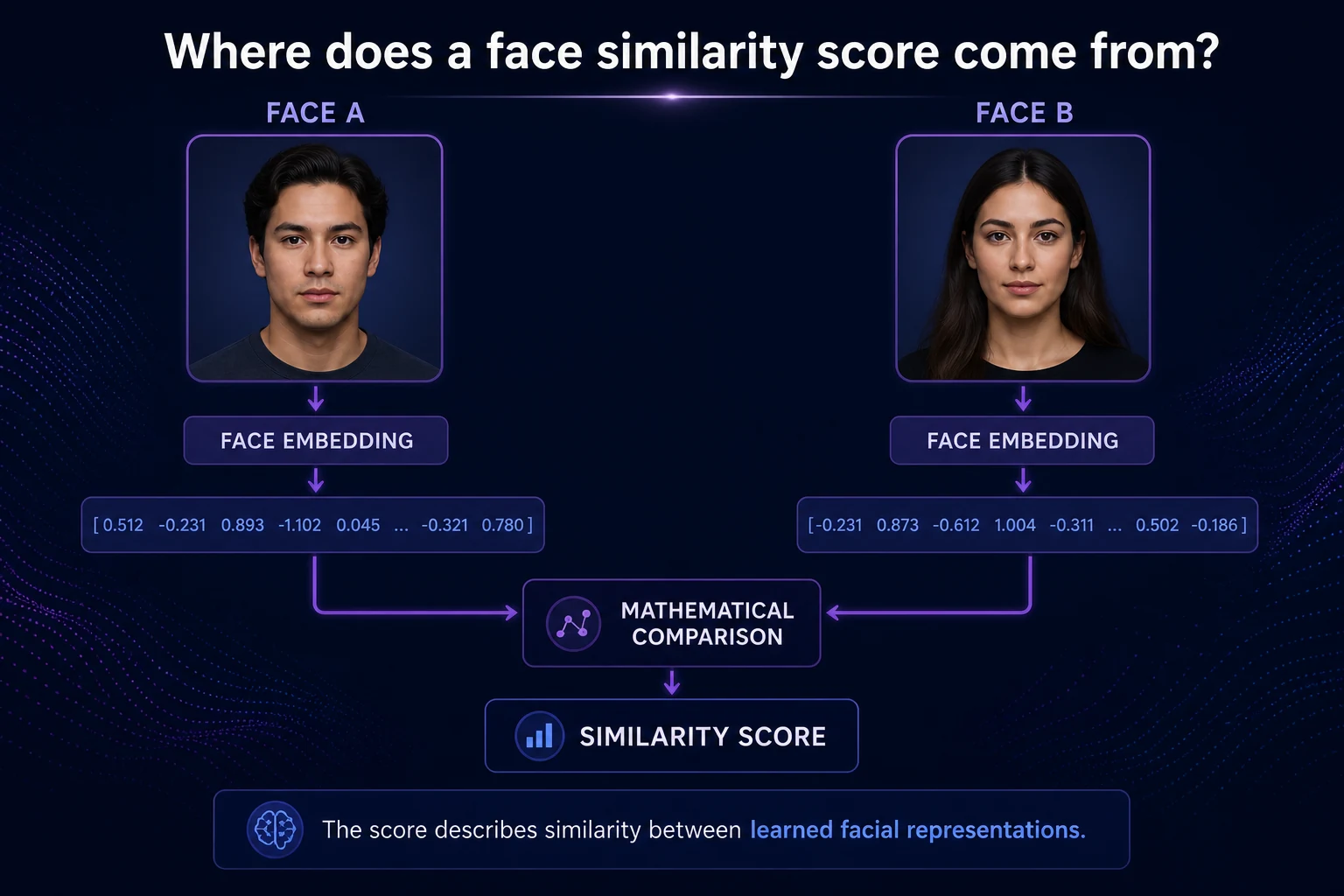
Instead, a recognition model processes the face and creates a numerical representation called a face embedding.
An embedding can contain hundreds of numerical dimensions. Together, those values represent facial information the model learned to use for recognition.
When a search is performed, the system can generate an embedding for the searched face and compare it with embeddings representing other faces.
Conceptually:
Face A → numerical embedding
Face B → numerical embedding
mathematical comparison → similarity
With normalized embeddings, cosine similarity is a common comparison method. Thresholds should be validated for the specific model and population rather than treated as universal constants.
Want the whole pipeline? See How Reverse Face Search Works.
The easiest way to understand it: distance on a map
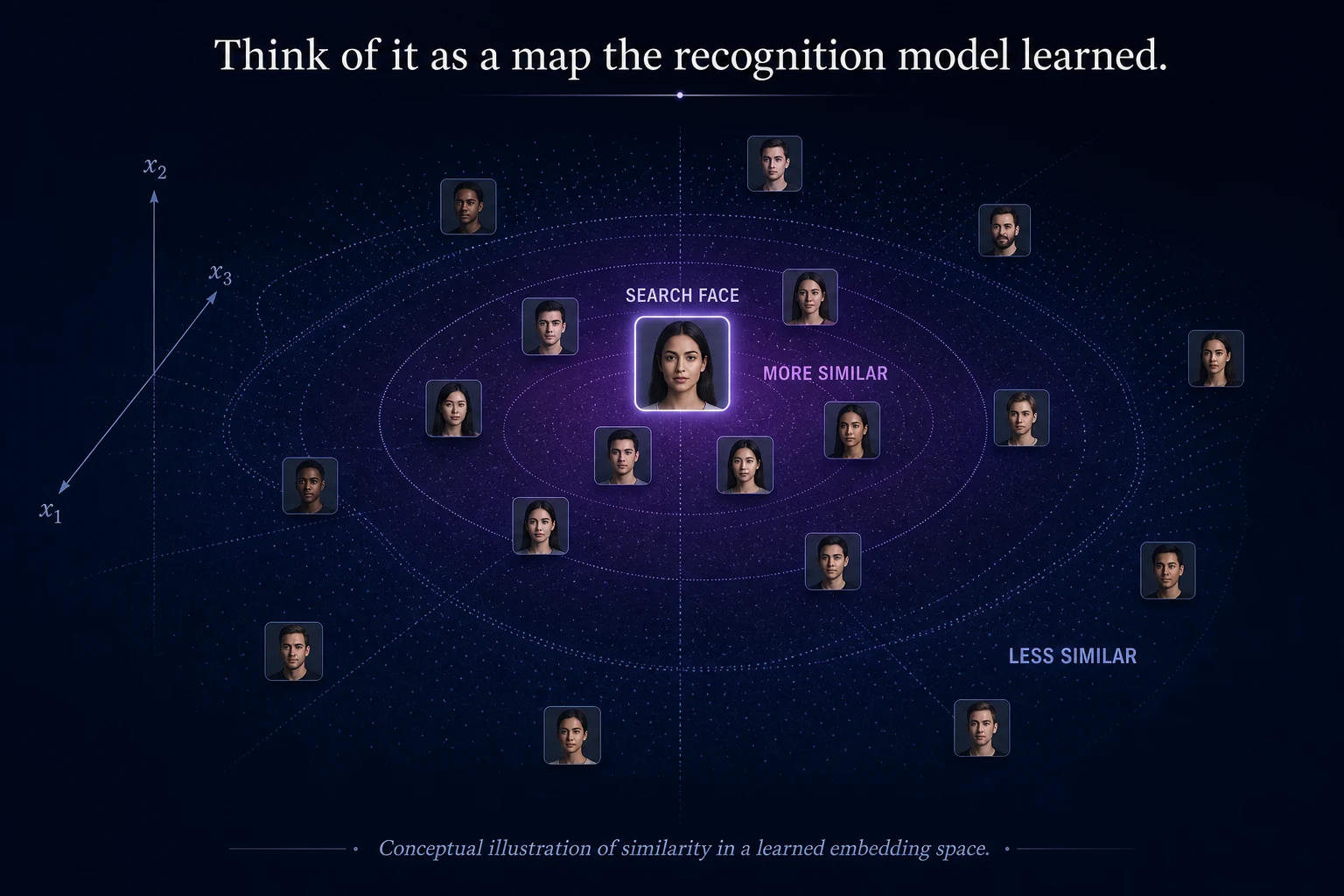
Imagine the recognition model has created an enormous mathematical map for faces.
Each face embedding represents a location in that learned space.
Photographs whose facial representations are more similar tend to be positioned closer together according to the model.
Representations that are less similar tend to be farther apart.
The similarity calculation gives the system a way to quantify that relationship.
But there's an important caveat:
the individual coordinates don't have simple human meanings.
You generally can't look at one embedding dimension and say:
"Dimension 37 represents nose shape."
The model learned the representation as a whole.
This is why face embeddings are fundamentally different from a checklist of physical facial measurements.
So what does "95% similarity" actually mean?
The exact answer depends on how a service creates that display value.
A facial-recognition model may internally produce a raw similarity or distance value.
A consumer-facing service can then transform that value into something easier to read, such as 95% similarity.
But unless the provider specifically documents and validates that value as a calibrated probability, it should not automatically be interpreted as:
There is a 95% chance these photographs show the same person.
Instead, think:
This candidate received a relatively strong similarity value according to this system's scoring and presentation method.
The exact meaning of the displayed number depends on how that particular system calculates and transforms its underlying scores.
NIST has cautioned that similarity-score distributions can differ substantially across algorithms, making raw scores from different recognition algorithms incomparable without appropriate evaluation or calibration. See NIST's FRTE 1:1 verification overview for how similarity scores and thresholds are evaluated. For the broader accuracy picture, read How Accurate Is Reverse Face Search?.
A similarity score is primarily useful for ranking
This is probably the most useful way for a CatchAFace user to think about it.
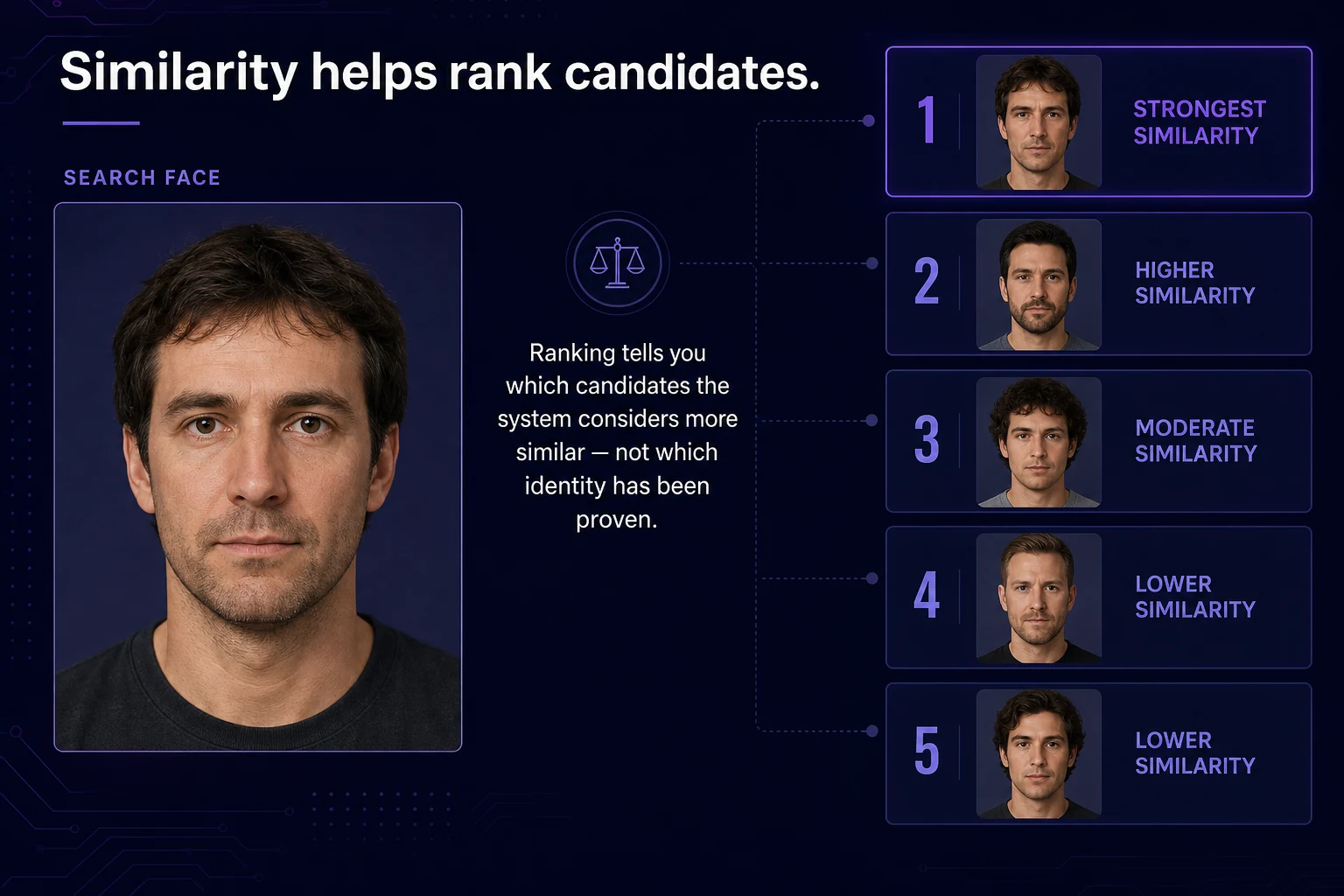
Imagine a search returns five candidates:
Candidate A — strongest similarity
Candidate B — slightly weaker
Candidate C — moderate
Candidate D — weaker
Candidate E — weakest
The score helps the search system answer:
Which candidates should we show first?
That's extremely useful.
It lets the system take potentially enormous numbers of facial comparisons and rank the most promising candidates near the top.
NIST's terminology for one-to-many facial identification similarly describes automated systems returning a candidate list ranked according to system-evaluated similarity.
But ranking doesn't transform the first result into a confirmed identity.
Similarity is not identity
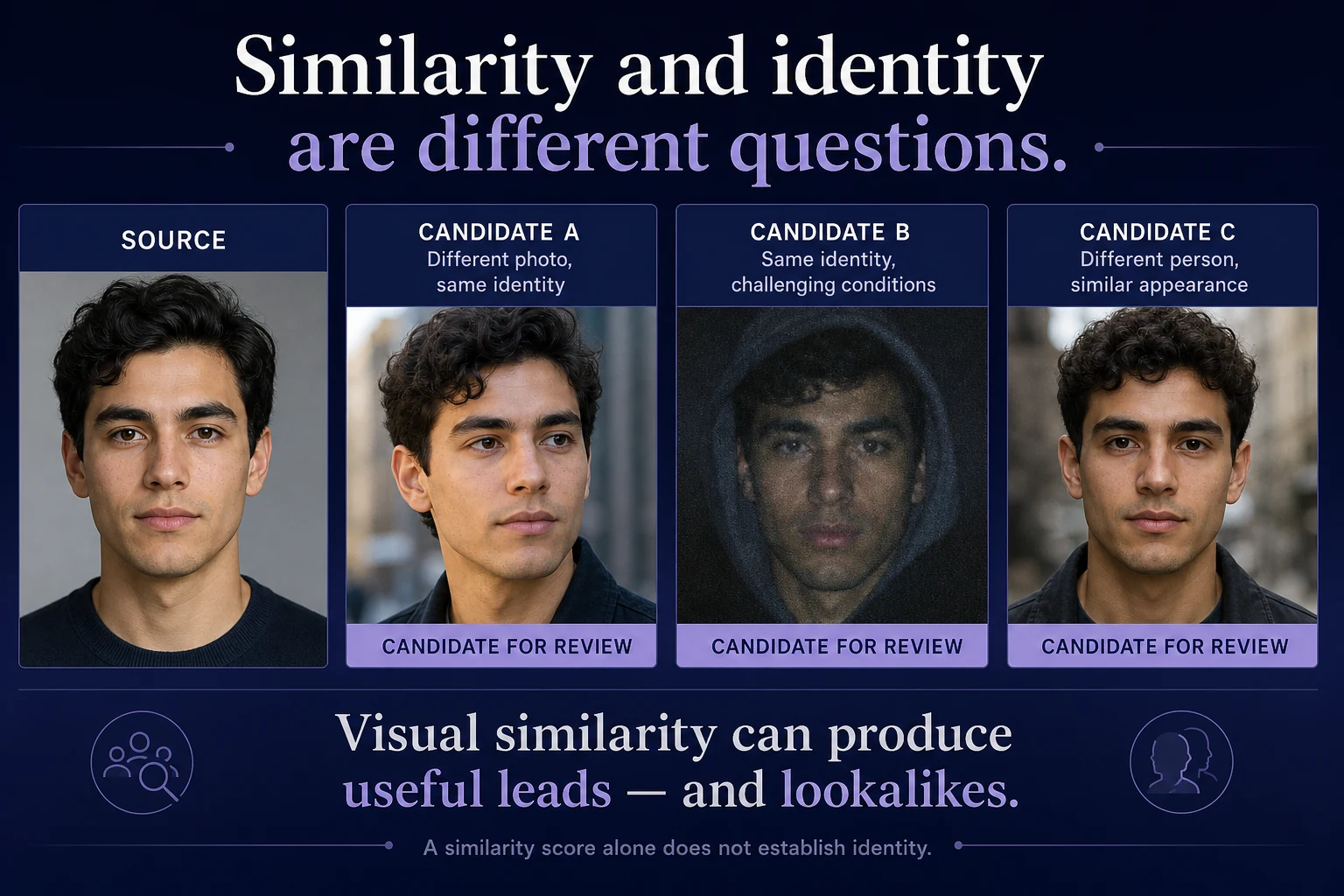
Two different people can look alike.
That's obvious to humans, and it's equally important when interpreting face-recognition results.
People can share facial characteristics strongly enough for their mathematical representations to receive relatively high similarity scores.
That's a false-match problem.
Conversely, two photographs of the same person can sometimes receive weaker similarity because of:
age;
extreme pose;
poor image quality;
obstruction;
lighting;
blur;
major appearance differences.
That's why the score itself isn't an identity verdict.
A high score deserves closer inspection.
A lower score deserves more skepticism.
Neither substitutes for context.
Why there isn't one universal "good" similarity score
People inevitably search for:
"Is 80% face similarity good?"
And there isn't a responsible universal answer.
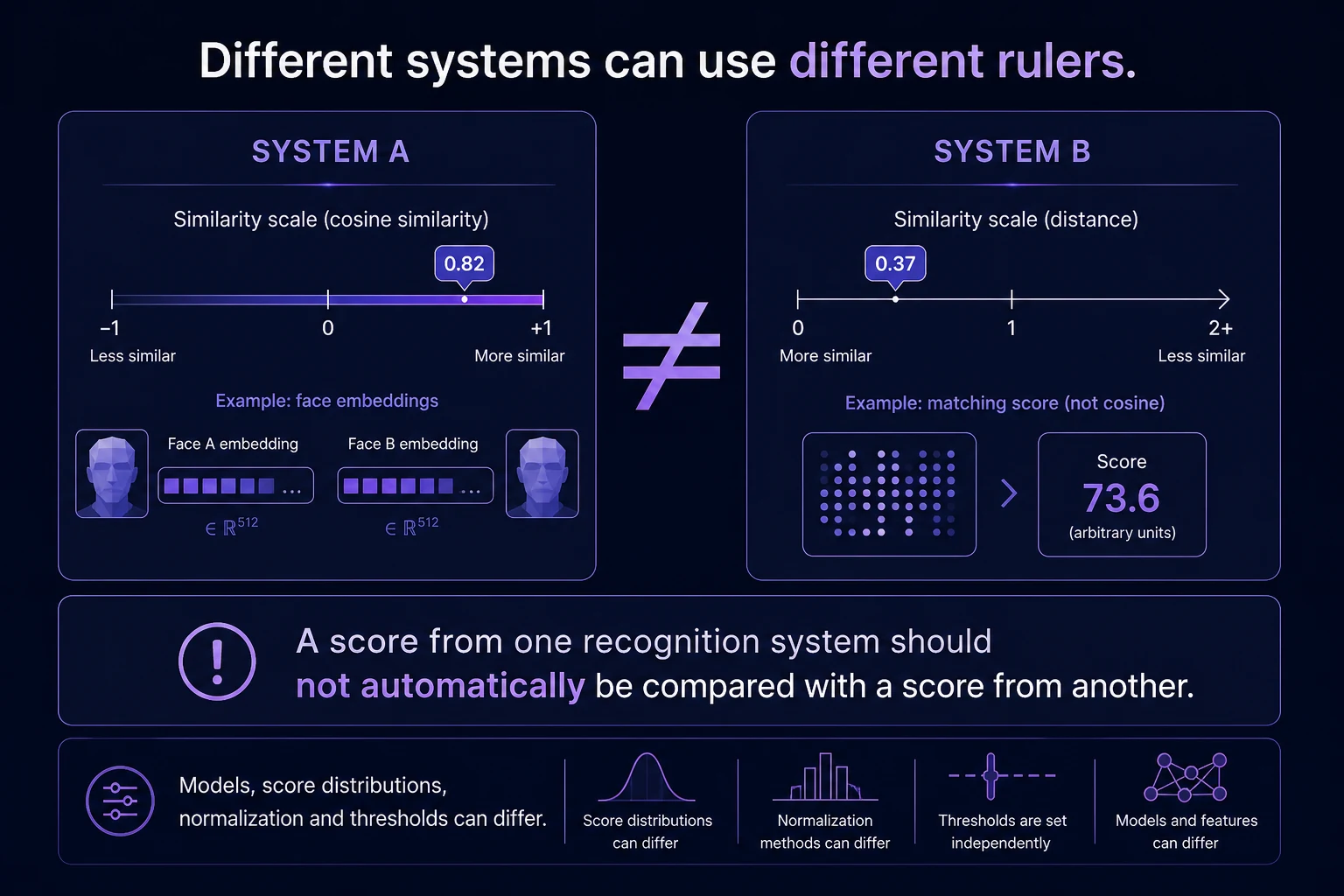
A score only makes sense in the context of the system that produced it.
Different recognition systems can use:
different models;
different embedding spaces;
different comparison functions;
different score ranges;
different normalization;
different thresholds;
different transformations for displaying results.
So:
An 80% displayed by Service A does not necessarily mean the same thing as an 80% displayed by Service B.
Two systems can use completely different internal score ranges and both convert them into friendly-looking percentages.
Thresholds depend on the model, training data, and population — and should be recomputed when the recognition model changes.
What is a similarity threshold?
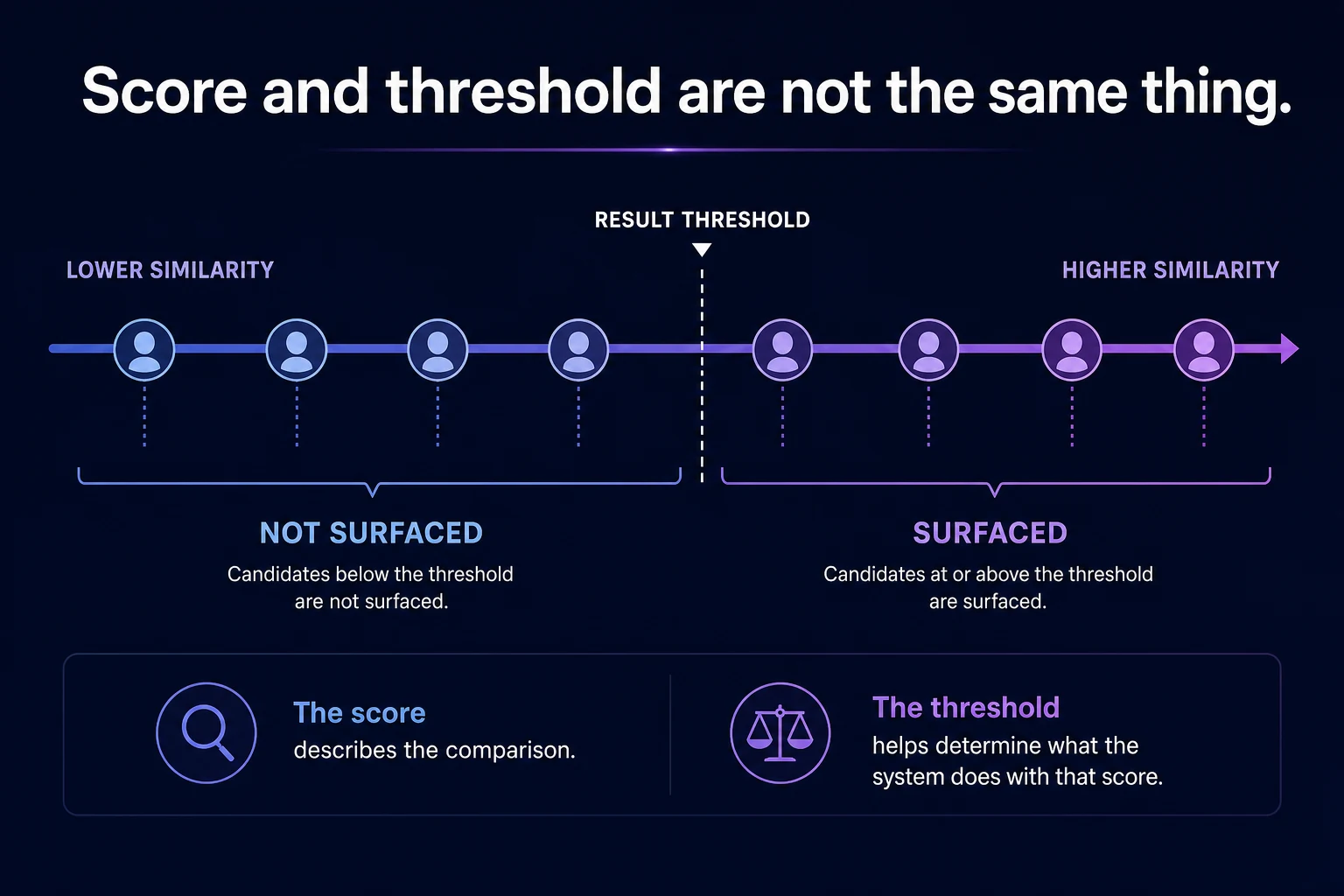
A search system can't display every facial comparison it performs.
It needs some way to decide which candidates are worth surfacing.
That's where a threshold comes in.
Conceptually:
Below threshold — The candidate isn't similar enough according to the system's chosen criteria.
Above threshold — The candidate qualifies to be surfaced or considered further.
Changing that threshold creates a tradeoff.
A stricter threshold can reduce weak or unrelated candidates — but may also miss useful matches.
A looser threshold can surface more possibilities — but may introduce more lookalikes.
NIST describes this same basic tradeoff: biometric similarity scores are compared with thresholds, and threshold choice affects false-match and false-non-match behavior. (No Face Search Results? covers what happens when nothing crosses the threshold.)
Why the same person doesn't always get the same score
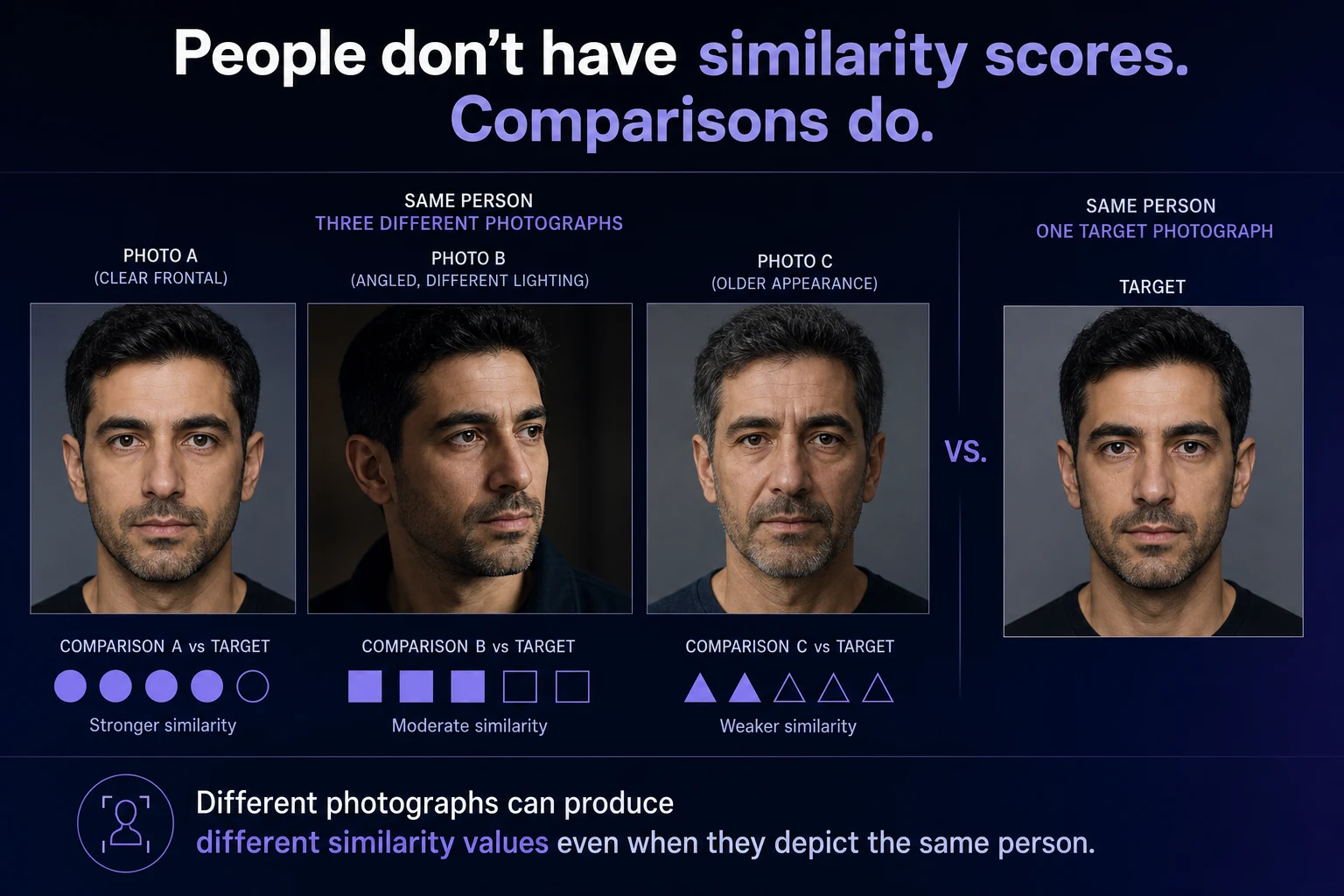
A similarity score belongs to the comparison between two images/embeddings, not permanently to a person.
Suppose you search using three photographs of yourself:
Photo A: clear frontal portrait
Photo B: dim photograph at an angle
Photo C: photograph from ten years earlier
Now compare each against the same target image.
You can get different similarity scores.
That's because each photograph produces its own facial representation.
Same identity.
Different images.
Different comparison.
Different score.
Can you convert similarity into probability?
Not automatically.
It is possible to build calibrated statistical systems that estimate probabilities or likelihoods from recognition evidence under defined conditions. That's an entirely different exercise from simply taking a cosine similarity value and adding a % symbol.
Research specifically exists on converting biometric comparison scores into probabilistically interpretable confidence estimates, which itself illustrates why raw similarity and probability aren't synonymous.
For a consumer reverse face-search interface, the safer interpretation is:
Similarity tells you how strongly the system ranked the facial comparison — not the statistical probability that you've established someone's identity.
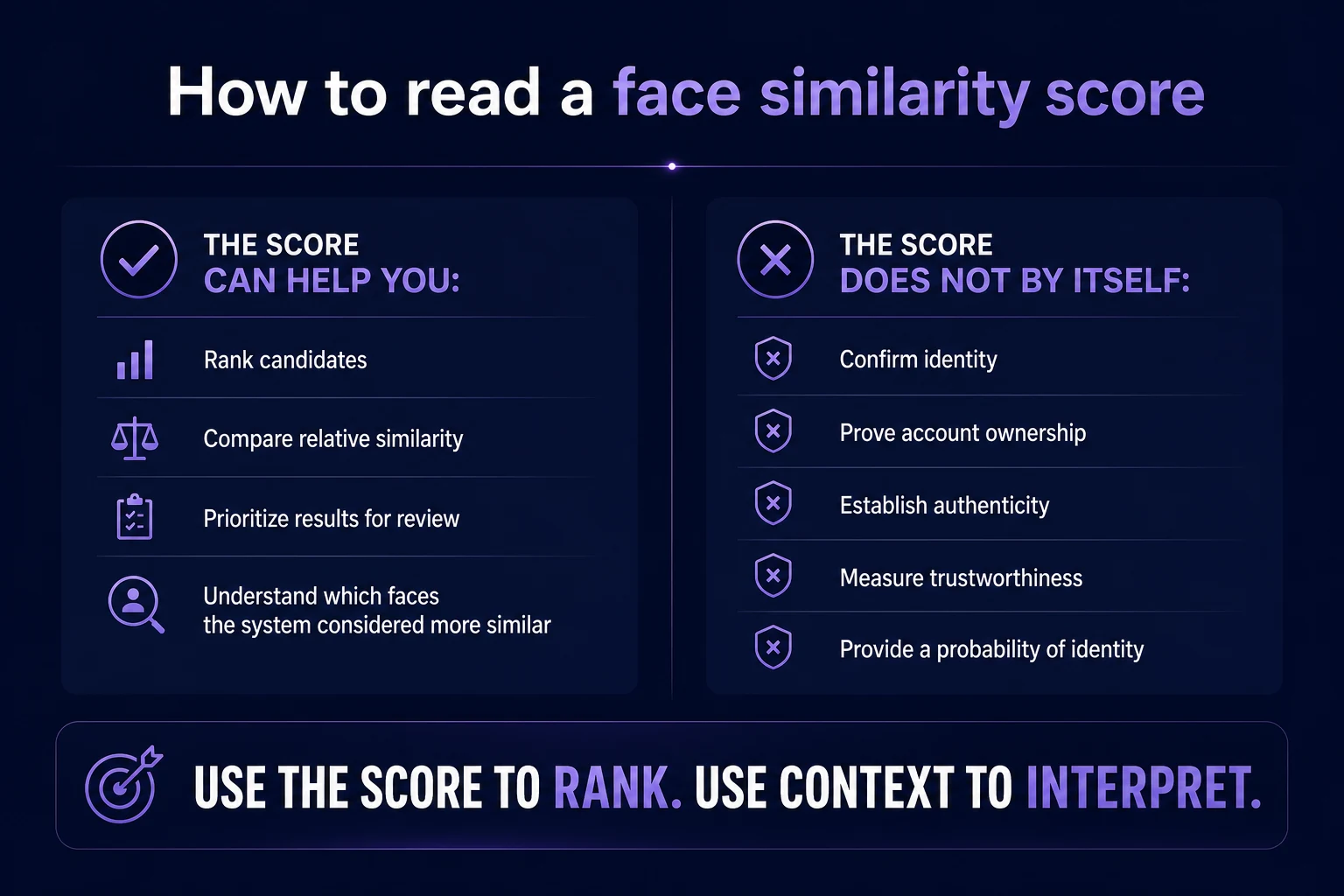
How should you actually use a similarity score?
Use it to prioritize.
Review stronger candidates before weaker ones.
Use it comparatively.
Within the same system and search, scores can help you understand how candidates were ranked.
Look at the image.
Does the candidate actually resemble the source?
Follow the source.
Understand where the image appeared and what context surrounds it.
Don't turn the number into proof.
A high score does not independently verify identity.
And don't ignore weak results simply because they fall below an arbitrary number you've decided means “real.” Challenging photographs can sometimes produce weaker similarity even for the same person.
Treat the score as a ranking signal, not a verdict
A face similarity score can be extremely useful.
It allows a recognition system to compare facial representations, rank candidates, apply thresholds, and surface the results most worthy of review.
But the number has limits.
95% similarity does not automatically mean a 95% chance of identity.
A score from one recognition system isn't necessarily comparable to the same-looking number from another. (Best Reverse Face Search Engines in 2026.)
And even photographs of the same person can produce different scores depending on the images being compared.
The simplest way to remember it is:
The score tells you how similar the system thinks two facial representations are.
You still have to decide what the result actually means.
Related Articles
Guides
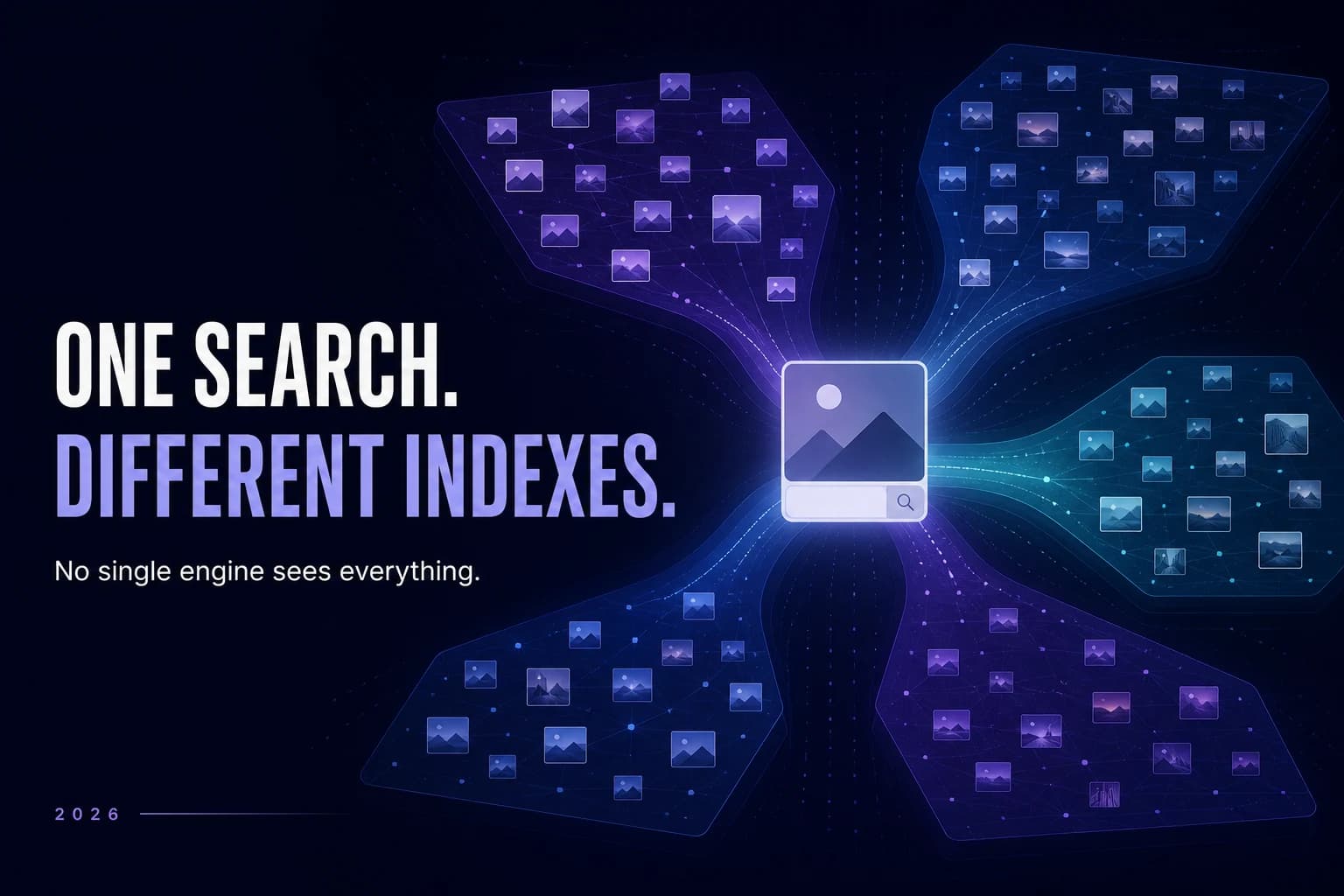
Best Reverse Face Search Engines in 2026
Reverse face search engines don't all search the same sources or present results the same way. Here's how the major face-search options in 2026 differ — and which type of tool may fit what you're trying to find.
9 min read
Face Search
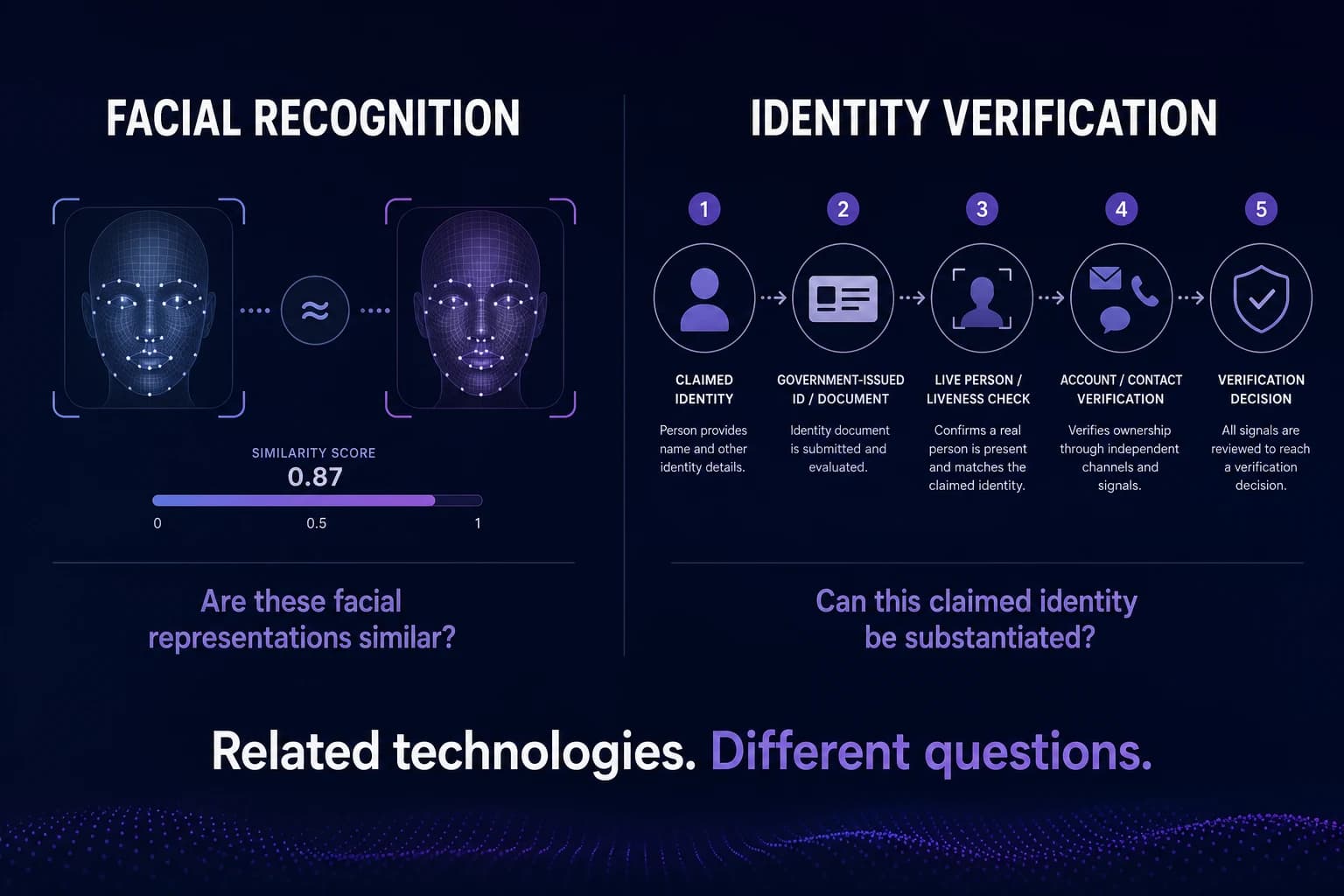
Facial Recognition vs. Identity Verification
Facial recognition and identity verification are often treated as the same thing. They aren't. Learn what each technology actually does — and why a face match by itself does not confirm identity.
6 min read
Face Search
How Accurate Is Reverse Face Search?
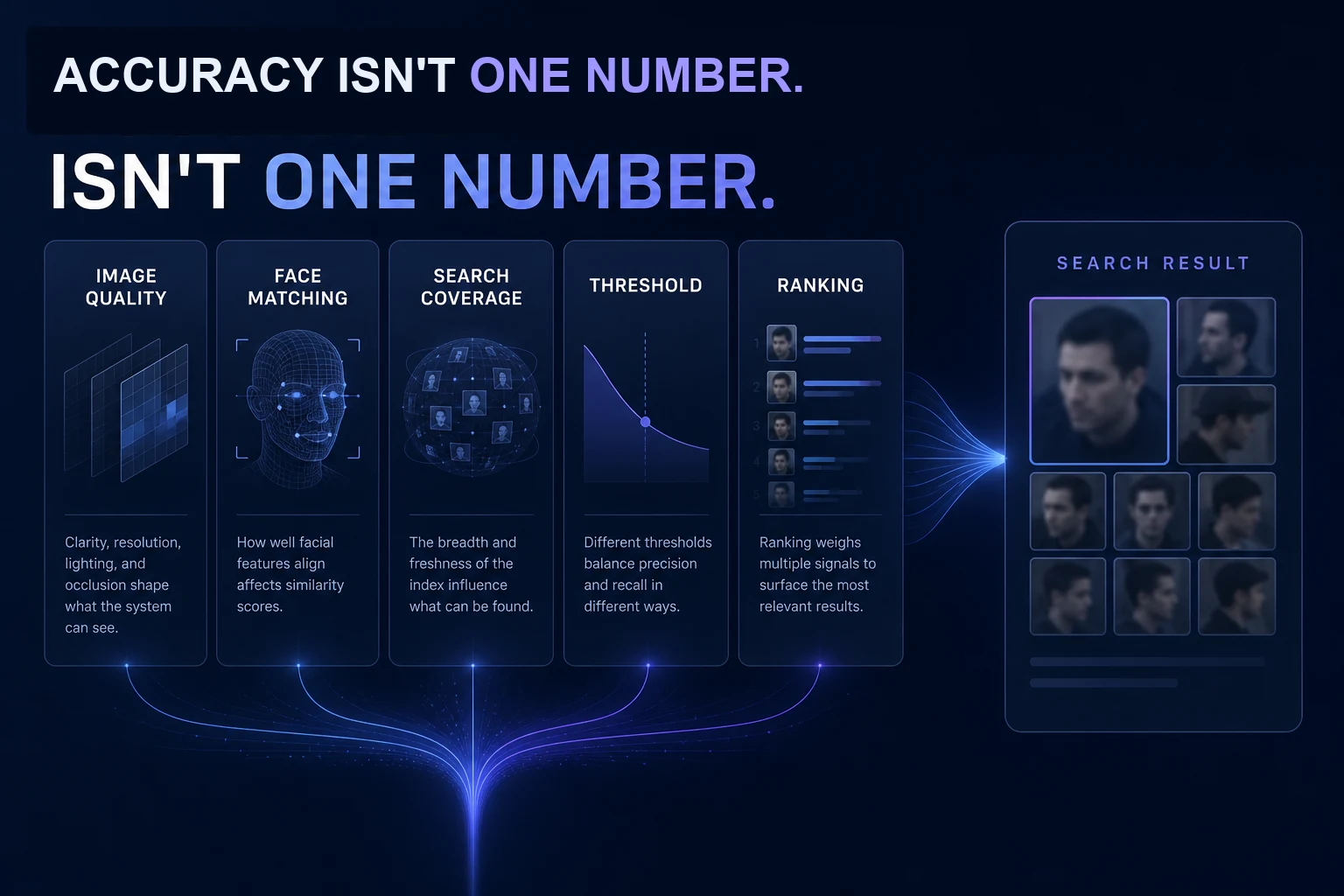
Modern facial recognition can be remarkably capable, but reverse face search accuracy isn't one simple percentage. Image quality, pose, thresholds, search coverage, and false matches all affect what you actually see.
7 min read