Face Search
Facial Recognition vs. Identity Verification
Facial recognition and identity verification are often treated as the same thing. They aren't. Learn what each technology actually does — and why a face match by itself does not confirm identity.
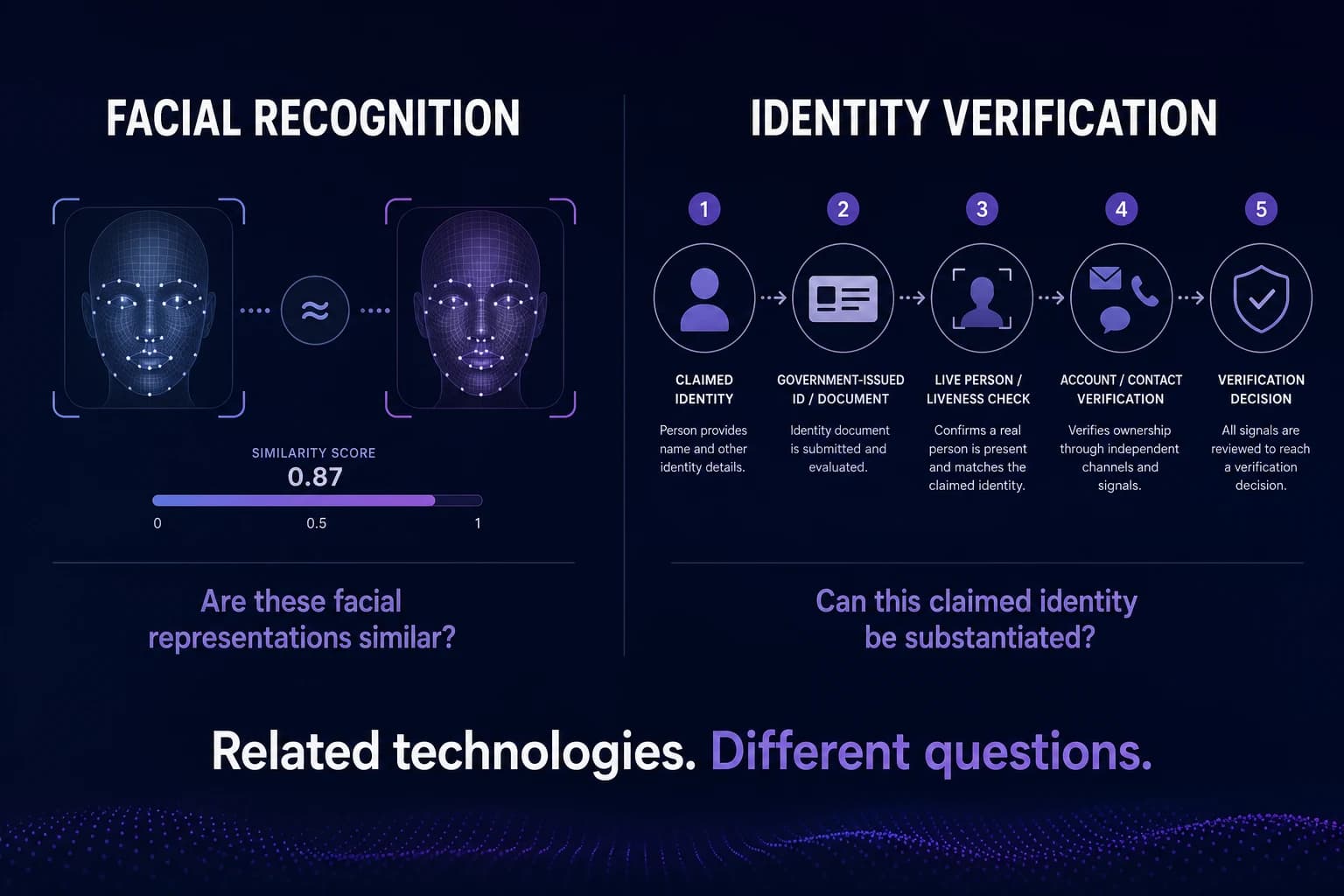
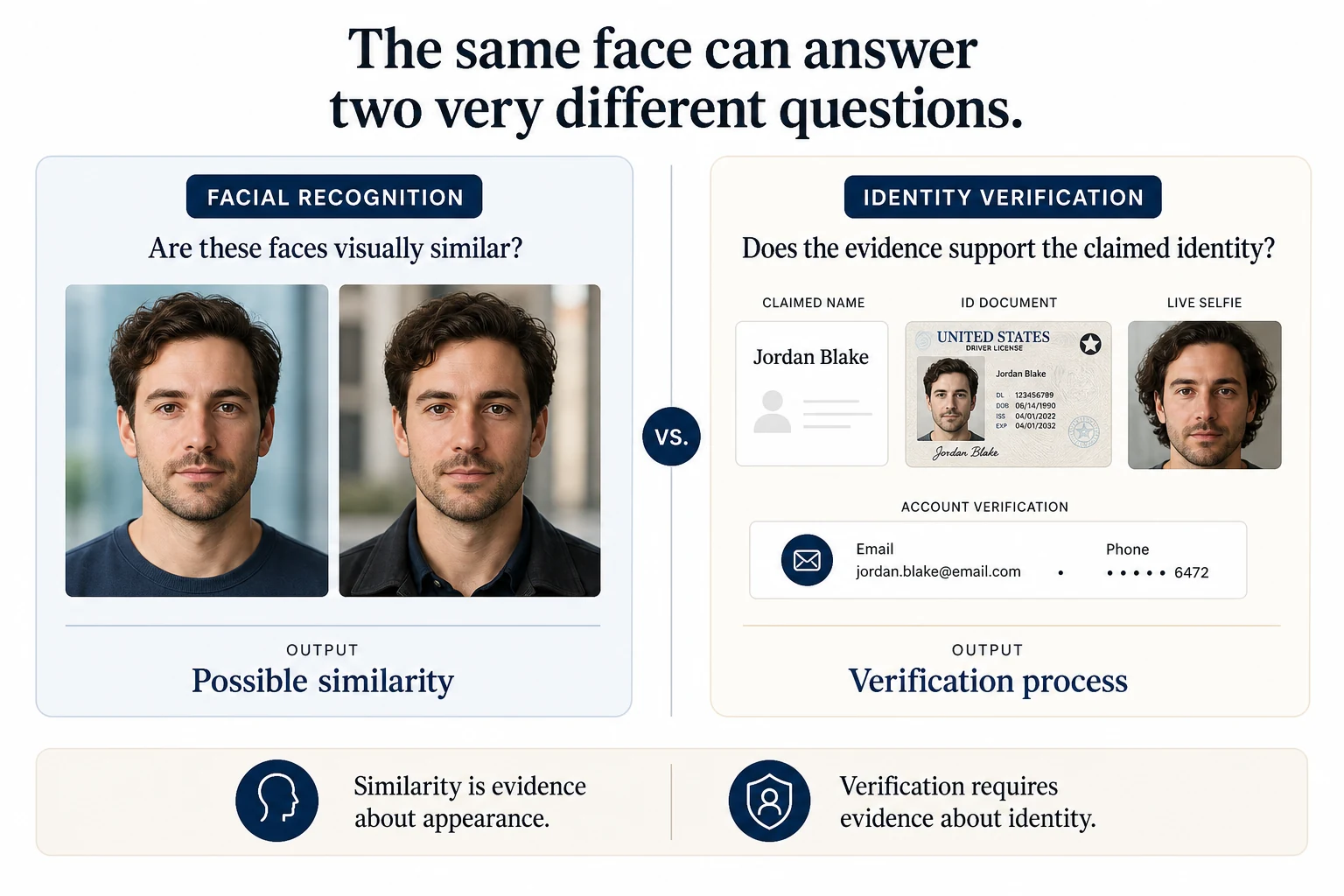
A face match can show similarity. It does not, by itself, establish identity.
The terms facial recognition and identity verification are often used interchangeably, but they describe different things.
Facial recognition is a technology for comparing faces.
Identity verification is a broader process for establishing that someone is who they claim to be.
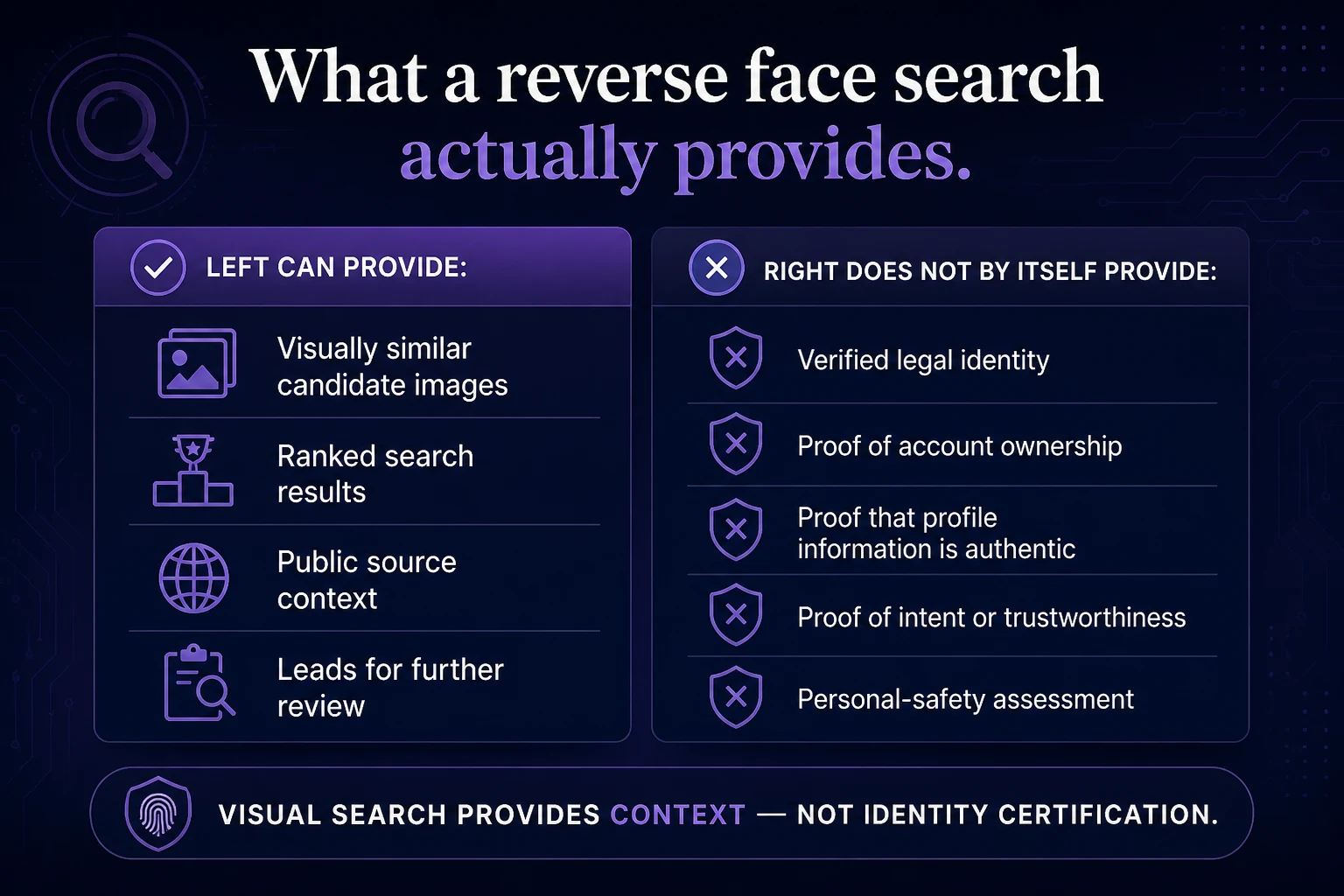
Sometimes facial recognition can be one component of an identity-verification system. But facial recognition alone does not automatically verify a person's legal identity, ownership of an account, authenticity of a profile, or truthfulness of the information surrounding an image.
That distinction matters whenever you're interpreting a reverse face-search result.
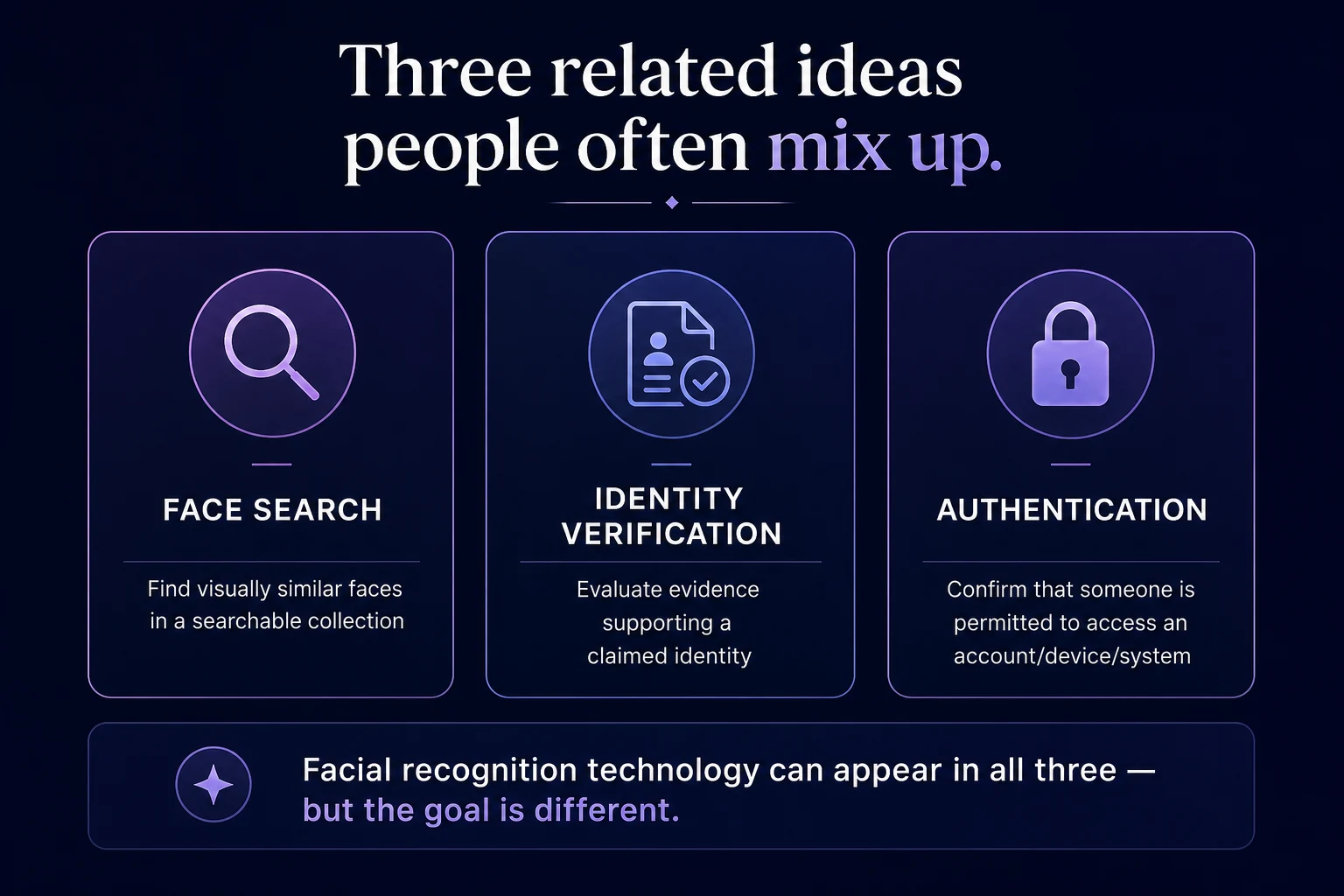
Facial recognition asks a comparison question
At its core, facial recognition analyzes facial information and compares one face with another facial representation or with a larger collection of face representations.
Depending on the system, the question may be:
Do these two face images appear similar?
or:
Which faces in this searchable collection are most similar to this one?
Modern recognition systems can generate numerical face embeddings and compare those embeddings mathematically.
The result may be expressed as:
a similarity score;
a confidence category;
a ranked candidate list;
a match/no-match decision based on a threshold.
What facial recognition does not automatically know is the real-world identity attached to that face.
It can compare what the face looks like.
It cannot infer a driver's-license number, legal name, date of birth, or whether someone truly owns the account where the image appeared simply from facial similarity.
For the technical side, see How Reverse Face Search Works.
Identity verification asks a different question
Identity verification starts with a claimed identity.
For example:
"I am Jane Smith."
The system then tries to determine whether there is sufficient evidence to support that claim.
Depending on the service and level of assurance required, that process might involve:
checking a government-issued identity document;
verifying document authenticity;
comparing a selfie with the document photo;
checking liveness;
validating an email address or phone number;
reviewing account history;
using other trusted records or authentication methods.
The important part is that identity verification connects a person to external evidence about who they claim to be.
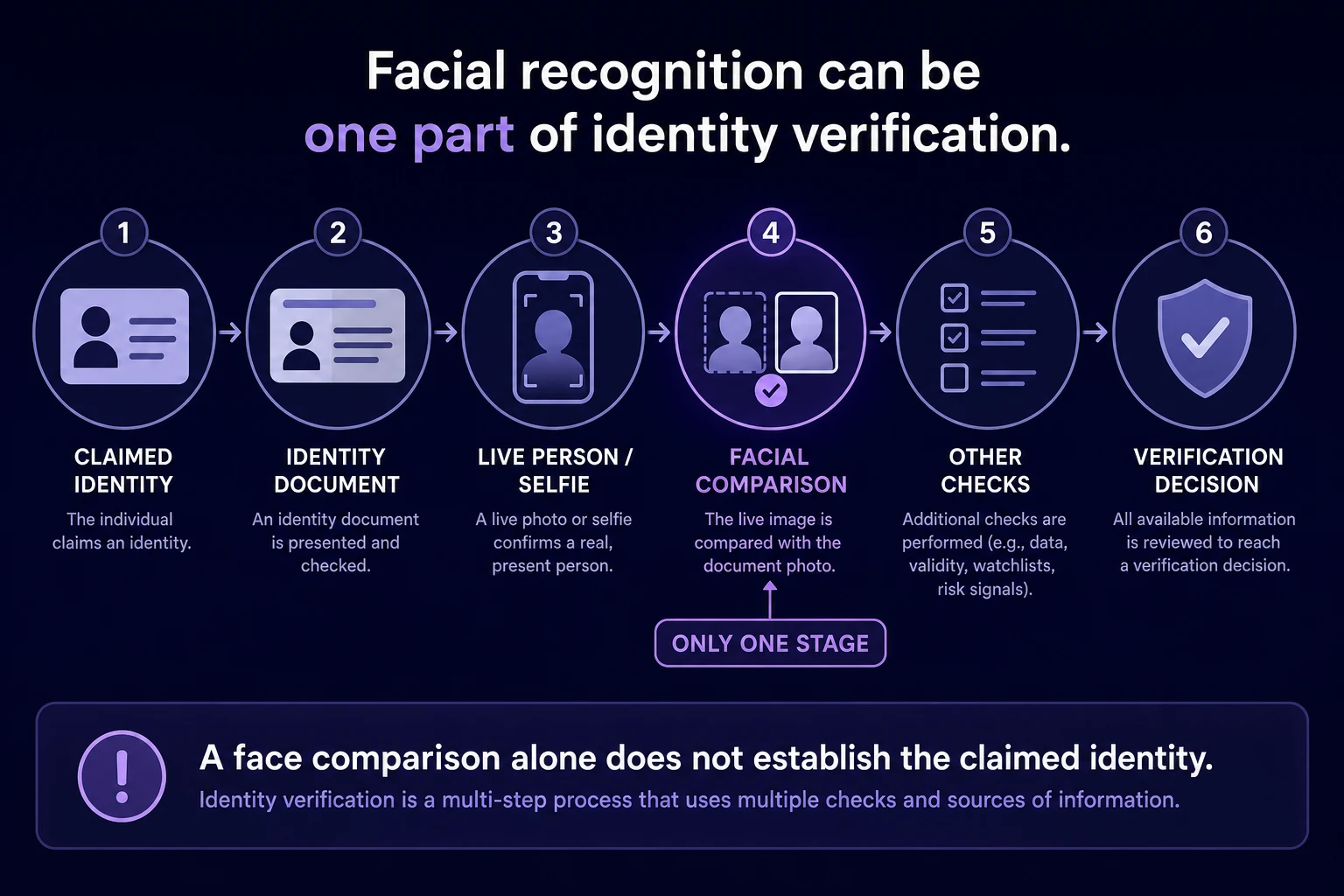
Facial recognition may be part of that process.
But it isn't the whole process.
The easiest way to remember the difference
Facial recognition | Identity verification | |
|---|---|---|
Question | Do these faces appear similar? | Is this person who they claim to be? |
Works with | Facial images or embeddings | A claimed identity plus supporting evidence |
Typical output | Similarity, ranking, candidate match | Verification decision or level of confidence |
Independently establishes legal identity? | No | That is the goal of the broader process |
May use facial recognition? | — | Yes, as one possible component |
Why reverse face search is not identity verification
This is the part that matters most to CatchAFace users.
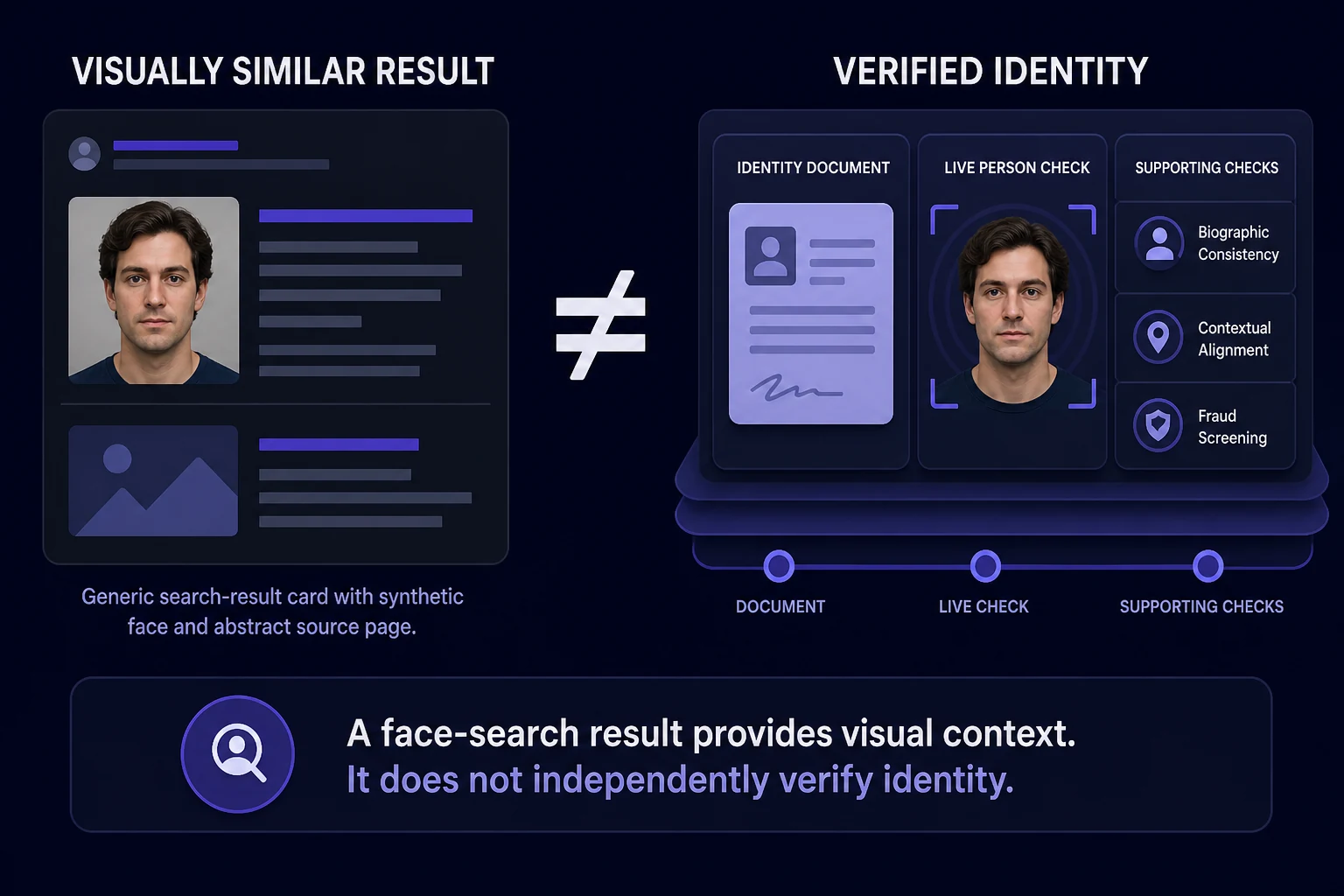
A reverse face-search result can surface a webpage containing a visually similar face.
That can be useful.
It may provide context.
It may lead you to another image, profile, article, or webpage worth reviewing.
But it doesn't independently prove:
the name on that page is correct;
the page belongs to the searched person;
the account is authentic;
the image wasn't misattributed;
two photographs definitely depict the same person;
the person is truthful;
the person is safe or trustworthy.
A face-search result is a lead. Identity verification is a separate evidentiary process.
What about "1:1" and "1:N" face recognition?
This helps clarify where facial recognition can fit inside verification.
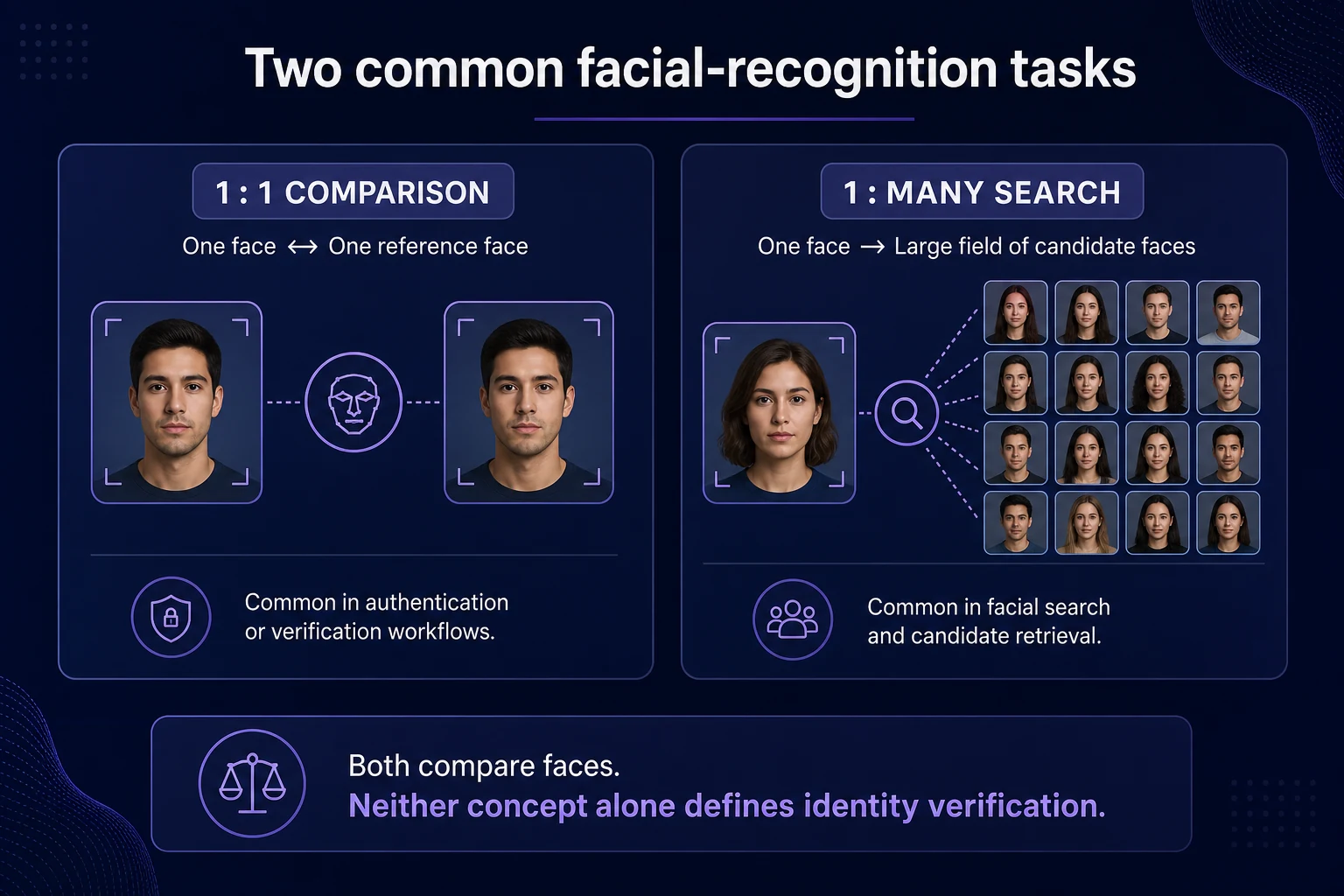
One-to-one comparison
A 1:1 facial comparison asks whether one face is sufficiently similar to one reference face.
For example:
live selfie ↔ photo printed on an identity document
That can be a component of identity verification.
But even then, the broader system usually still needs confidence that the document itself is legitimate and belongs to the claimed identity.
One-to-many search
A 1:N search compares one face against many indexed faces to find the most similar candidates.
Reverse face search is much closer to this type of problem.
It asks:
Which faces in the available searchable collection are most similar?
That produces candidates.
It doesn't automatically supply a verified identity.
Can identity verification use facial recognition?
Absolutely.
This is where the terms become related.
Imagine an identity-verification flow:
A person claims an identity.
They provide an identity document.
The document is checked.
They capture a live selfie.
Facial recognition compares the selfie with the document portrait.
Liveness or anti-spoofing checks help determine whether a real person is present.
Other information may also be validated.
The system makes a verification decision.
Facial recognition helped answer:
Does the live face resemble the face on this reference document?
The wider verification system tries to answer:
Does the available evidence support this claimed identity?
Those aren't the same question.
Authentication is another related term
This is worth clarifying because readers will encounter it constantly.
Identity verification often happens when establishing who someone is.
Authentication generally asks whether someone should be allowed access to an account or system.
Face recognition can also be used there.
For example:
Your phone already knows which enrolled facial template belongs to the authorized device owner.
When you attempt to unlock it, the system compares your current face against that enrolled reference.
That's authentication.
It isn't searching the public web for your identity.
And it isn't the same thing as reverse face search.
What does "verified" actually mean?
This word deserves caution.
A “verified” identity is only as strong as:
the evidence reviewed;
the verification method;
the quality of the data;
anti-fraud controls;
the standards used by the service;
and what exactly the provider means by “verified.”
For example, verifying access to an email account is not the same thing as verifying a government identity.
Matching a selfie to a supplied portrait is not necessarily the same thing as validating the source of that portrait.
A blue checkmark on a platform can represent yet another process entirely.
So whenever a service uses the word verified, ask:
Verified against what?
Why CatchAFace avoids calling itself identity verification
CatchAFace is designed to help surface visually similar public images and give users context around those results.
It is not designed to make a legal or authoritative identity determination.
That's why CatchAFace separates:
visual similarity
from verified identity
A search may help you discover something worth reviewing.
It should not replace the judgment and evidence required for a true identity-verification process.
Related reading: What Does a Face Similarity Score Mean?, How Accurate Is Reverse Face Search?, and No Face Search Results? What That Actually Means.
Similarity and identity are not interchangeable
Facial recognition can be extremely useful.
It can compare faces, rank candidates, assist authentication systems, and serve as one component within broader identity-verification workflows.
But the technology itself answers a narrower question:
How similar are these facial representations?
Identity verification asks something larger:
Does the available evidence support who this person claims to be?
That's why a reverse face-search result should be treated as context rather than certification.
A similar face can point you toward something worth reviewing.
It doesn't eliminate the need to determine what that result actually represents.
Related Articles
Face Search
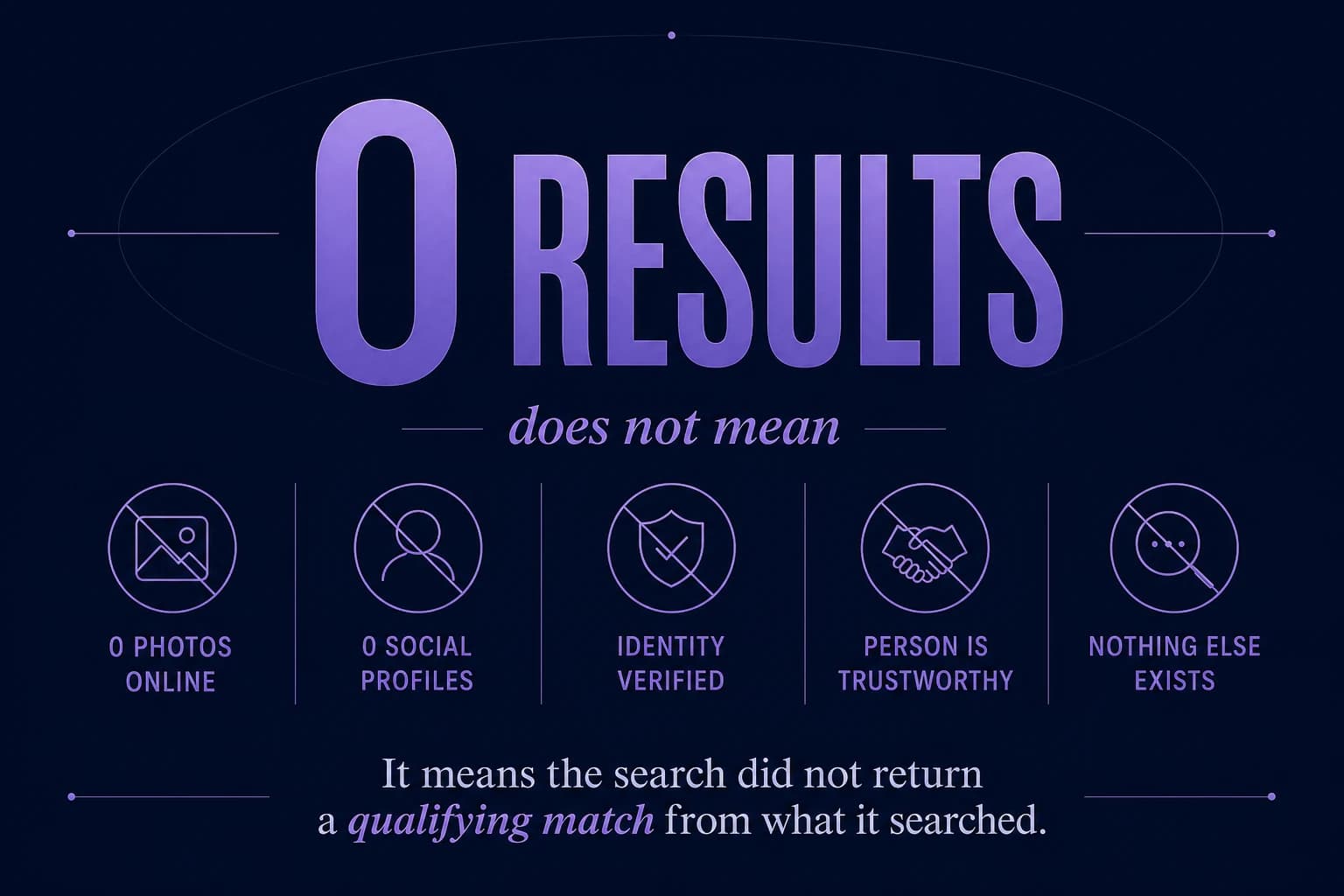
No Face Search Results? What That Actually Means
A reverse face search returned nothing. Does that mean the person has no other photos online? Not necessarily. Here's what zero results actually tells you — and what it doesn't.
7 min read
Face Search
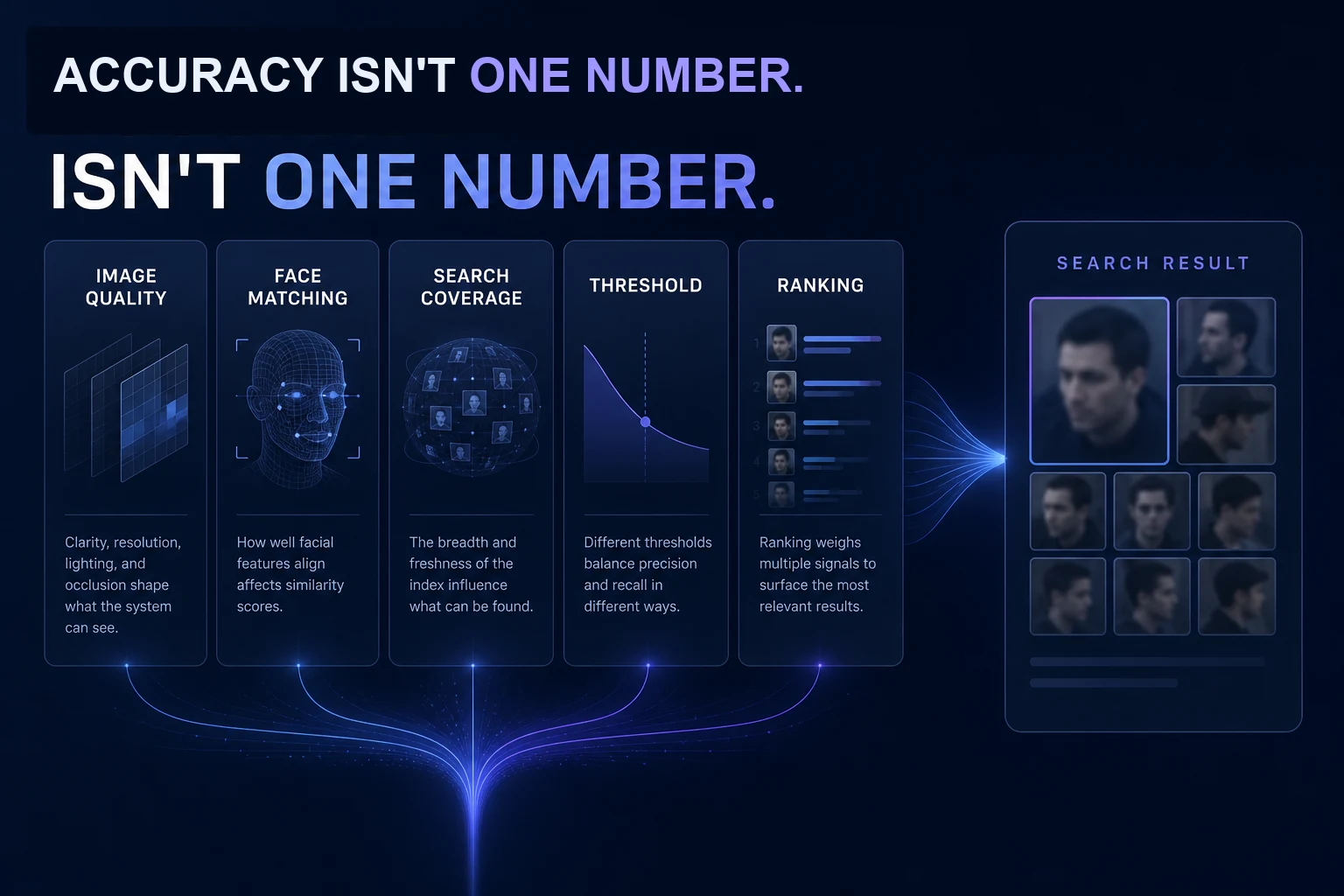
How Accurate Is Reverse Face Search?
Modern facial recognition can be remarkably capable, but reverse face search accuracy isn't one simple percentage. Image quality, pose, thresholds, search coverage, and false matches all affect what you actually see.
7 min read
Responsible Use
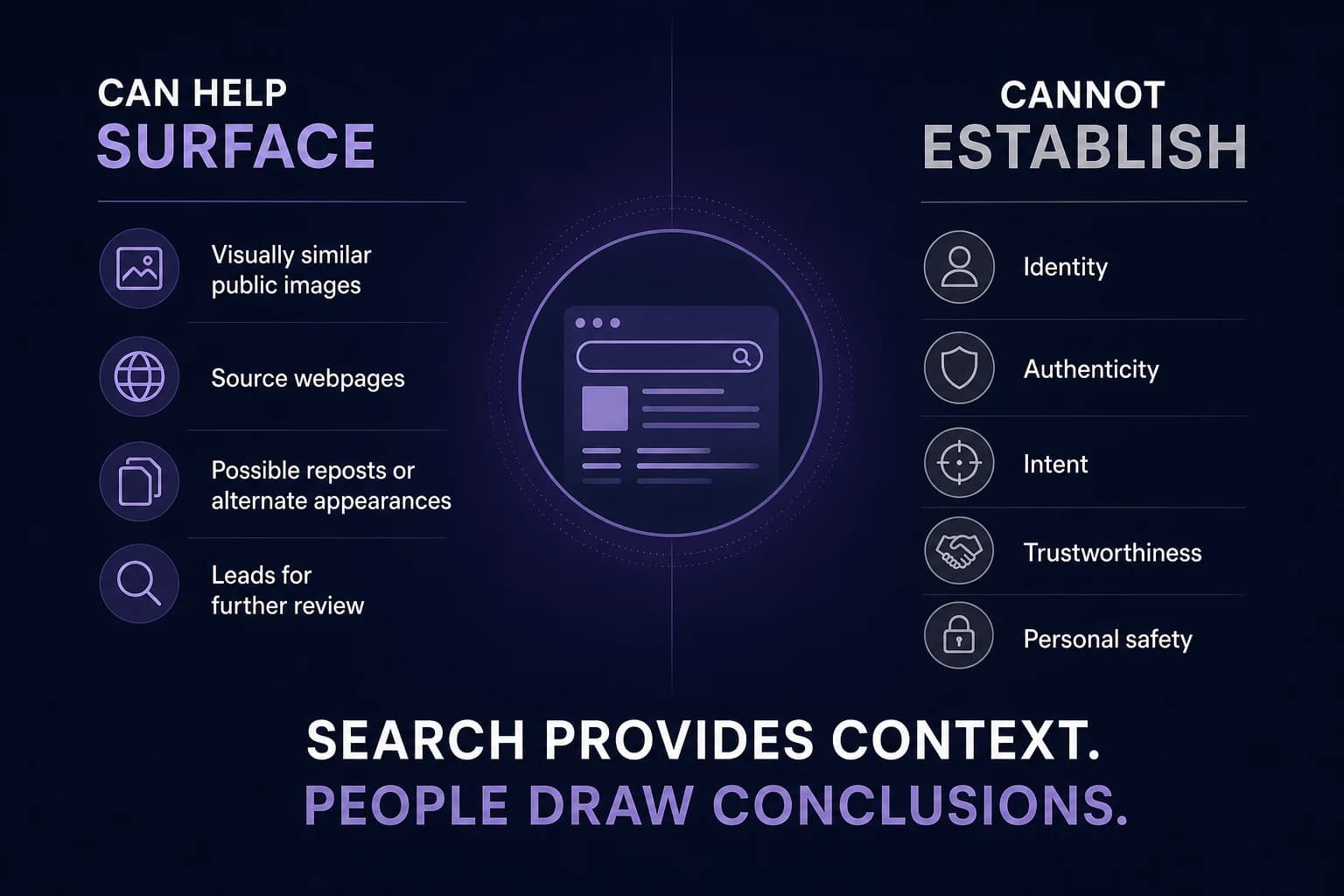
What Reverse Face Search Can—and Cannot—Tell You
Reverse face search can surface visually similar public images and useful source context, but it has important limits. Here's what a result can tell you — and what it cannot.
7 min read